
Senior Estimator, Hospitality
Hospitality, Reimagined: The Rise of Fitness in Hospitality, From Amenity to Expectation
Walk into a hotel gym from fifteen years ago and you’d likely find a couple of treadmills, a universal weight machine, and a television mounted too high to actually watch. That era is over.
Today, the fitness center has become one of the most consequential spaces in a hotel and it’s a direct signal of how seriously an ownership group takes the guest experience. For developers, operators, and brands navigating renovation cycles and Property Improvement Plans (PIP), understanding this shift isn’t optional. It’s central to staying competitive.
The Numbers Don’t Lie
The market backdrop tells the story clearly. The Global Wellness Institute’s 2025 Global Wellness Economy Monitor values the world wellness economy at $6.8 trillion, with projections to reach $9.8 trillion by 2029. The global wellness tourism market alone was estimated at nearly $1 trillion in 2025 and is projected to reach $2.4 trillion by 2035, growing at a compound annual rate of 9.3%, according to Grand View Research. For hotel owners and operators, those numbers represent a fundamental shift in what guests are willing to pay for and what they expect to find when they arrive.
Guests Have Raised the Bar
Today’s guests are marathon trainers, ClassPass regulars, recovery-focused professionals, and longevity-driven consumers. They judge a hotel not just by the comfort of the room, but by the caliber of the gym, as Athletech News reported earlier this year. Properties that invest in wellness are seeing real, measurable returns. Properties with major wellness offerings generated 22% higher RevPAR and 18% higher ADR than properties with no wellness investment in 2024, according to RLA Global’s 2025 Wellness Real Estate Report.
What “Good” Looks Like Now
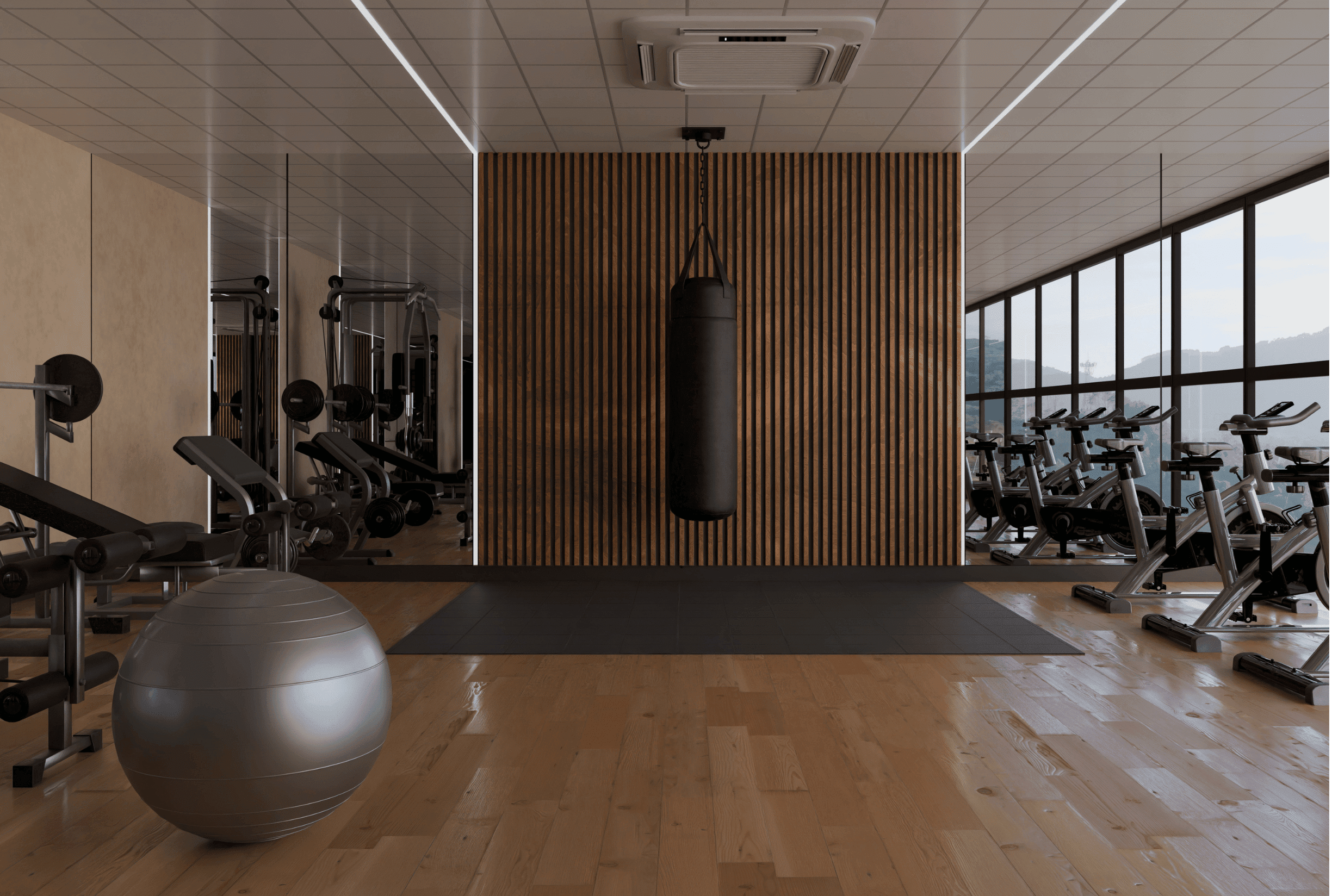
The design conversation has evolved considerably. The fitness center is now a primary signal of a brand’s quality and a direct driver of guest loyalty and that shows up in the construction scope. Space allocations have grown. Equipment mixes have shifted toward versatile, multi-functional layouts over rows of single-purpose cardio machines. According to Hotel Business, the next wave in hospitality design is invisible wellness – spaces that subtly enhance physical and mental well-being through lighting, acoustics, materials, and spatial flow, with circadian lighting, biophilic design, and air-quality-conscious materials becoming standard.
For owners going through a PIP, it also means getting the infrastructure right: electrical capacity for modern equipment loads, HVAC to manage heat and humidity, flooring systems built for the acoustic and load demands of a serious fitness floor. The finish is only as good as the bones behind it.
The Bottom Line
As Barak Hirschowitz, President of the International Luxury Hotel Association, noted in Athletech News: “Hotels must think like wellness operators, not amenity providers.” The fitness center isn’t a box to check on a brand standards form. It’s a revenue-influencing, guest-retaining asset. Ownership groups who treat it that way, and who partner with construction teams that understand the full scope of delivering these spaces correctly, are the ones positioned to win.